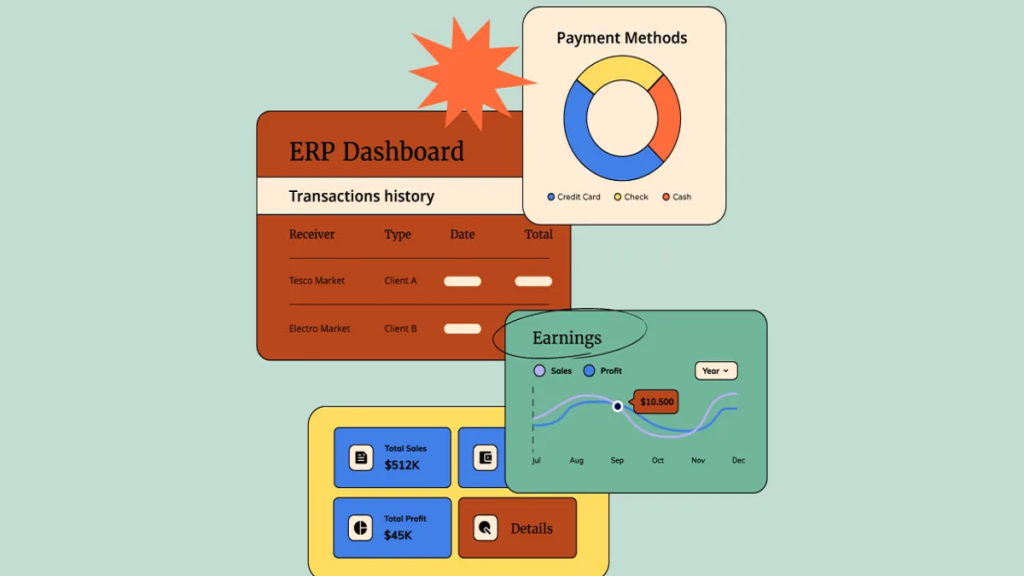
ERP software is an integrated application that helps organizations analyze, manage, and automate the core daily operations across multiple departments. Organizations can use the best ERP software to manage core business processes through a centralized system.
Enterprise Resource Planning (ERP) is among the fastest-growing enterprise software categories, driven by the need for centralized data and operational efficiency. It brings key business processes together into one software package, which can be used throughout the organization.
ERP systems typically include modules such as finance, sales and marketing, HR, procurement and logistics, and other functions that improve operational efficiency, streamline processes, and enhance data management.
Best ERP Software
1. Oracle NetSuite
NetSuite is an Oracle-owned cloud ERP solution, operating as part of Oracle’s enterprise software portfolio. NetSuite includes suites: ERP (Enterprise Resource Planning), CRM (Customer Relationship Management), E-Commerce, Professional Services Automation, and Human Capital Management.
With NetSuite OneWorld, NetSuite supports multi-currency operations and the management of multiple subsidiaries and business entities. Some of its features include:
- Financial management features that have built-in business intelligence.
- Financial planning features can shorten cycle times and improve your planning process.
- Order management features that can quicken the order-to-cash process.
- Features and functionalities for procurement, warehouse and fulfillment, supply chain management, production management, and other operational capabilities.
2. Microsoft Dynamics 365
This is a strong ERP option for organizations that have already adopted the Microsoft software ecosystem (MS Teams, MS Project, MS Office). Microsoft Dynamics 365 will offer a familiar feel and interface for anyone accustomed to MS platforms, making adoption easier for Microsoft-savvy organizations.
Additionally, organizations can choose which of their applications they want to implement to better customize their experience and pricing. Microsoft Dynamics 365 supports small, mid-sized, and large organizations, depending on the modules and deployment chosen. Some of its key features include:
- Customer Insights and Service.
- Marketing and Sales.
- Sales Insights.
- Guides.
- Business Central.
- Commerce.
- Finance and Operations apps.
- Human Resources (merged infrastructure).
- Supply chain management and related ERP capabilities.
3. SAP S/4HANA
SAP is widely recognized as a market leader in enterprise ERP solutions, particularly for large and complex organizations. It is one of the most widely adopted ERP solutions, and it holds a significant share of the ERP market.
SAP S/4HANA is SAP’s ERP business suite for large organizations. SAP S/4HANA has strong real-time data processing capabilities and can be deployed in different places, like on-premises, in the cloud, or in a hybrid.
It comes with an in-memory interactive database management system named HANA (High-Performance Analytics Appliance), which is chiefly used for advanced analytics and data processing. Some of its features include:
- Built-in intelligent technologies like AI, machine learning, and advanced analytics.
- In-memory database.
- Simplified data model.
- Capabilities and best practices for a wide range of industries.
4. Tally Prime
TallyPrime is a tried-and-tested business ERP solution apt for small and medium businesses. While its interface is more traditional compared to modern cloud ERPs, TallyPrime remains highly functional and reliable.
TallyPrime offers a secure server environment to store and manage your company’s crucial data, providing employees with a unified source of information. With TallyPrime Server, data updates are reflected in real time, guaranteeing that all employees have the latest data.
TallyPrime Server also offers administrators monitoring capabilities to manage and observe user sessions and activities. Key features include:
- Invoicing and Accounting.
- Inventory Management.
- Insightful Business Reports.
- Credit and Cash Flow Management.
- Taxation and Banking.
- Multi-task Capabilities.
- Access Business Data Online.
5. Oracle ERP Cloud
Oracle offers a wide variety of Enterprise Resource Planning products catering to particular areas, like PeopleSoft and JD Edwards. This one is a cloud-based ERP solution from Oracle. It includes many software modules like Financials Cloud, Procurement Cloud, Risk Management Cloud, and related ERP modules.
There is also a dedicated mid-market ERP cloud offering that helps mid-sized organizations to implement ERP cloud and support smoother business operations and reduce operational costs. Some of its key features include:
- Broad and integrated functionality across finance, HR, supply chain, and customer experience.
- Easier to understand the complete picture of your company’s finances and operations.
- Updates the cloud every 90 days, offering you the latest capabilities.
6. ERPNext
This one is a free, open-source ERP application that is a remarkable choice for small and mid-sized businesses with limited resources seeking an open-source ERP solution. ERPNext has been translated into over 70 languages, provides smart device apps for iOS and Android, and offers personalized training in any paid plan.
SMBs can track leads and customers, create subscription plans, and launch loyalty programs. Organizations should be prepared for self-hosting and hands-on technical management when using the open-source version. ERPNext also provides extensive documentation and video resources. Some of their features are:
- API and Accounting.
- Activity Dashboard.
- Billing and Invoicing.
- Bills of Material.
- CRM and Customer Database.
- Customizable Reports.
- Distribution Management.
- Document Management.
- Enterprise Asset Management.
- Financial analysis and much more.
Read More: 9 Answer Engine Optimization Tools
7. Epicor ERP
Epicor ERP is aimed at manufacturers, distributors, retailers, and service providers in small, medium, and large-scale organizations. It offers ERP and retail solutions that together handle Point of Sale (POS), e-commerce, and customer relationship services.
It also incorporates modern technologies, including cloud computing, mobility, and real-time analytics. Epicor offers a familiar interface for Windows users. Epicor supports real-time operational insights through integrations with PLCs and IoT-enabled systems, depending on configuration. Key features include:
- Social-style collaboration features.
- DocStar ECM (Enterprise Content Management) can empower your teams to master content workflow.
- Virtual agents can streamline routine tasks.
- Modern design with an interface that is easy to adopt.
8. Oracle JD Edwards EnterpriseOne
Oracle offers yet another enterprise-grade ERP solution, the JD Edwards. Besides traditional ERP modules, EnterpriseOne also provides features like commodity trading and risk solutions and environmental health and safety management functions. JD Edwards is used in numerous industries, including packaging, manufacturing, and distribution.
JD Edwards also offers a solution named JD Edwards UX One, which offers an advanced user experience. Some of their specific characteristics are:
- Solutions for consumer-packaged goods, manufacturing and distribution, and industries such as asset-intensive and projects and services.
- Solutions such as financial management, project management, asset lifecycle management, order management, manufacturing management, etc.
- Oracle’s IaaS, PaaS, and SaaS solutions can help to maximize investment in JD Edwards EnterpriseOne on-premise solutions.
- JD Edwards with Oracle Cloud supports growth, allows business agility, and helps reduce operational cost and deployment risk.
- Better security and cost-effective application distribution and management.
9. Odoo ERP
Odoo is a flexible, open-source ERP system that helps businesses handle everyday operations such as accounting, inventory, sales, purchasing, and manufacturing from one place. Instead of forcing companies into a fixed setup, Odoo allows them to start with the modules they actually need and add more as the business grows.
Its modern layout and straightforward navigation also make it easier for teams to get comfortable with the system in a short time. This platform works particularly well for small and mid-sized businesses looking for an ERP solution that can scale with changing requirements.
Odoo can be used in the cloud or installed on-premises, giving organizations control over how they deploy and manage their system. Backed by regular updates and an active global community, it offers a reliable alternative for companies that want a customizable ERP without being tied to a single, closed ecosystem.
How to Decide From Various Options of ERP Solutions:
Before finalizing the best ERP software for your business, consider these:
User Interface (UI): Is it simple and user-friendly?
Usability: Is it easy to learn and understand? Does the software provide good tech support, user support, tutorials, and training?
Streamlined Features: Are there built-in features to help with accounting, inventory and warehouse management, and marketing?
Reporting and Analytics: Does it provide customizable, strong reporting and analytics options to track business performance? Are reports easy to create and share?
Integrations: Can it connect with other tools? Are there any pre-built integrations of the software?
Value for Money: How suitable is the price for the features, capabilities, and use? Is pricing transparent and flexible?
Real-time updates: Does the system support real-time updates on items like registering, new purchase orders, or invoice payments?
FAQ
Q: What is an ERP system, and how does it work?
A: An ERP system incorporates, manages, and controls different business procedures and functionalities through a series of unified and complementary modules that support functions including accounting, manufacturing, production, sales, built-in CRM capabilities, timesheets, and much more.
Q: Who uses the best ERP software?
A: The tools can be used by small, medium, or large organizations. Anyone interested in incorporating and connecting many business processes simultaneously can benefit from using ERPs.
Q: Which ERP systems are most commonly used?
A: Common ERP software does not necessarily mean “the best”; instead, it is typically promoted by big tech businesses that are dependable in their field. Some common ERP tools you may have heard of are NetSuite, Microsoft Dynamics 365, Oracle ERP Cloud, Oracle JD Edwards, and ERPNext.