Two vital design aspects are User Interface (UI) and User Experience (UX). Both are related to people using a product but looking at things differently. UI focuses on the visual elements of how somebody interacts with a particular product, such as typography, colors, menus, etc. UX focuses more on how the users use that product.
The two are clearly related and sometimes designed in similar ways, but there are many differences. Deciding on the core user experience should come before the aspects of user interface design. There are the best UI/UX design tools that come into play. Whether focusing on UX or UI or trying to bring them together, you need quality tools to achieve your goals.
Best UI/UX Design Tools
1. Sketch
Anybody familiar with UI design knows about Sketch. It is one of the most popular and best UI/UX design tools. Sketch allows designers to apply global changes using symbols, text styles, and reusable components.
The tool helps to save designers time in delivering reliable prototypes. It takes the tiresome jobs out of the designers’ work so they can start creating afresh. Sketch also offers a variety of plug-ins that can be incorporated with it. Like this, designers can use various other tools fully compatible with Sketch.
2. Figma
Figma has become a go-to UI/UX design tool thanks to its real-time collaboration features and browser-based accessibility. Designers, developers, and stakeholders can work together on the same file without worrying about operating systems or version conflicts, making teamwork faster and more transparent.
Beyond interface design, Figma supports wireframing, interactive prototyping, and design systems in one place. Its component-based approach and strong developer handoff features help teams maintain consistency while moving efficiently from concept to production.
3. Penpot
Penpot is an open-source UI/UX design tool built for teams that value flexibility and transparency. It runs in the browser and works across operating systems, making it easy for designers and developers to collaborate without worrying about platform limitations or licensing restrictions.
What sets Penpot apart is its developer-friendly approach. Designs are created using open web standards like SVG and CSS, which makes handoff smoother and more accurate. This makes Penpot a strong choice for teams that want a modern design workflow without being locked into proprietary tools.
4. Balsamiq
Balsamiq is a well-known UI wireframing tool that can reproduce the experience of sketching on a tablet or whiteboard on a computer. You can use it to generate ideas and communicate about the structure of the software or website you are creating.
Of course, you should have a good interface formation before you conclude your visual design or write any code. Balsamiq allows you to focus on structure and content rather than being distracted by elements like colors and other details prematurely. You will find several in-built and community-generated UI controls and icons.
You can easily make templates, masters, and reusable and customizable element libraries you can include in future designs. Balsamiq’s linking capabilities allow you to produce simple prototypes for demos or performance testing.
5. Axure RP
Axure helps UI/UX designers to develop prototypes and to keep track of the workflow. It offers a smooth documentation interface for its users. The prototypes from Axure are extremely well-detailed.
Axure also comes with several other tools. It helps designers to test functionalities. It also helps to put everything together to assist in easy developer exchange. With easier communication, every team member is updated and notified of vital changes and developments in real-time.
6. Marvel
No, we aren’t talking about the studio that presented Ironman, Hulk, or Thor. This UI design tool is known for making the design process easy for both beginners and professionals alike. It can help designers to produce high and low-fidelity wireframes. It can also be used to generate interactive prototypes and perform user testing.
Marvel’s interface is very intuitive. It comes with a feature called Handoff. Designers can use it to get all the required CSS (Cascading Style Sheets) styles and HTML (HyperText Markup Language) code.
Read More: 9 Video Interview Tools to Enhance Remote Hiring
7. Framer
Framer is a robust design tool to produce striking interactive designs, all on the canvas. You can design realistic websites and apps quickly with built-in interactive elements, polished resources, layout tools, and much more. It can design UI for apps for iPhones, Android, macOS, and many more.
You can select from a range of ready-to-use templates to save your time and stimulate any project, design, or wireframe. These comprise UI kits, like a Landing Page Kit, a Material Design Kit, and an iOS Kit. Additionally, Framer comes with various project management design templates, interactive design templates, website design templates, app design templates, and much more.
8. Proto.io
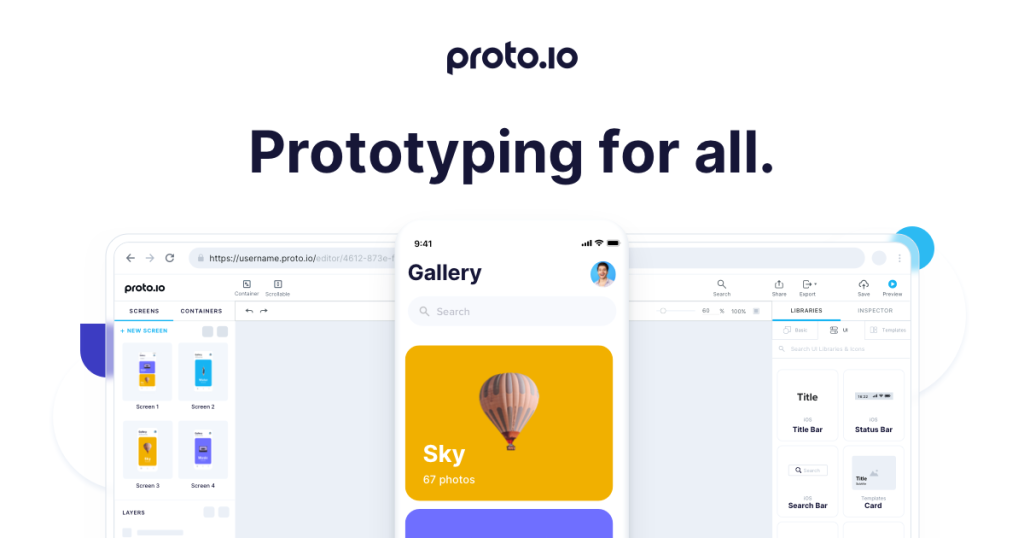
Proto.io offers designers everything they must have to manage, create, test, and incorporate perfect mockups. It makes the collaboration procedure much smoother, helps to develop communication between team members through video feedback and comments, and provides integration with some of the most popular and famous testing tools. Proto.io is quite famous among students, as learning the software is very easy.
9. Origami Studio
Origami Studio offers the essential tools to design, animate, and prototype all-in-one software. Yet, it works surprisingly well with other design software—importing from design software like Sketch or InVision is as simple as copying and pasting. This is a free design solution that lets designers develop and share interactive interfaces quickly.
It comes with a canvas where you can visually drag, drop, and resize to outline your prototype. Draw and edit various shape layers, text, and images; insert videos; and add layers imported from Sketch or InVision. You have the ability to group, mask, animate, and modify layers.
Use in-built elements to accelerate your workflow and create your library to share. Visually outline your elements in the Canvas and unite them with robust interactions in the Patch Editor.
Why Should You Use a UI/UX Tool?
The best UI/UX design tools help designers to make interactive and visually appealing digital apps. The following processes benefited from UI/UX design tools during the design procedure:
- User testing.
- Wireframing.
- Prototyping.
- Visual design.
- Optimization.
- Collaboration and handoff.
FAQ
Q: What are the 4 types of UI (user interface)?
A: The 4 types of UI are:
- Graphical User Interface (GUI).
- Command Line Interface (CLI).
- Menu-driven user interface.
- Touch-based user interface.
Q: What are the best UI/UX design tools for free?
A: There are various free wireframing tools. Penpot, Figma, and Miro are some companies offering such tools. However, the entire design suite is not free.
Q: How are these tools different from drawing tools?
A: These tools are much more technical and practical. These tools allow you to outline a fully working prototype. After all, you can’t design an app in MSPaint.